09:02
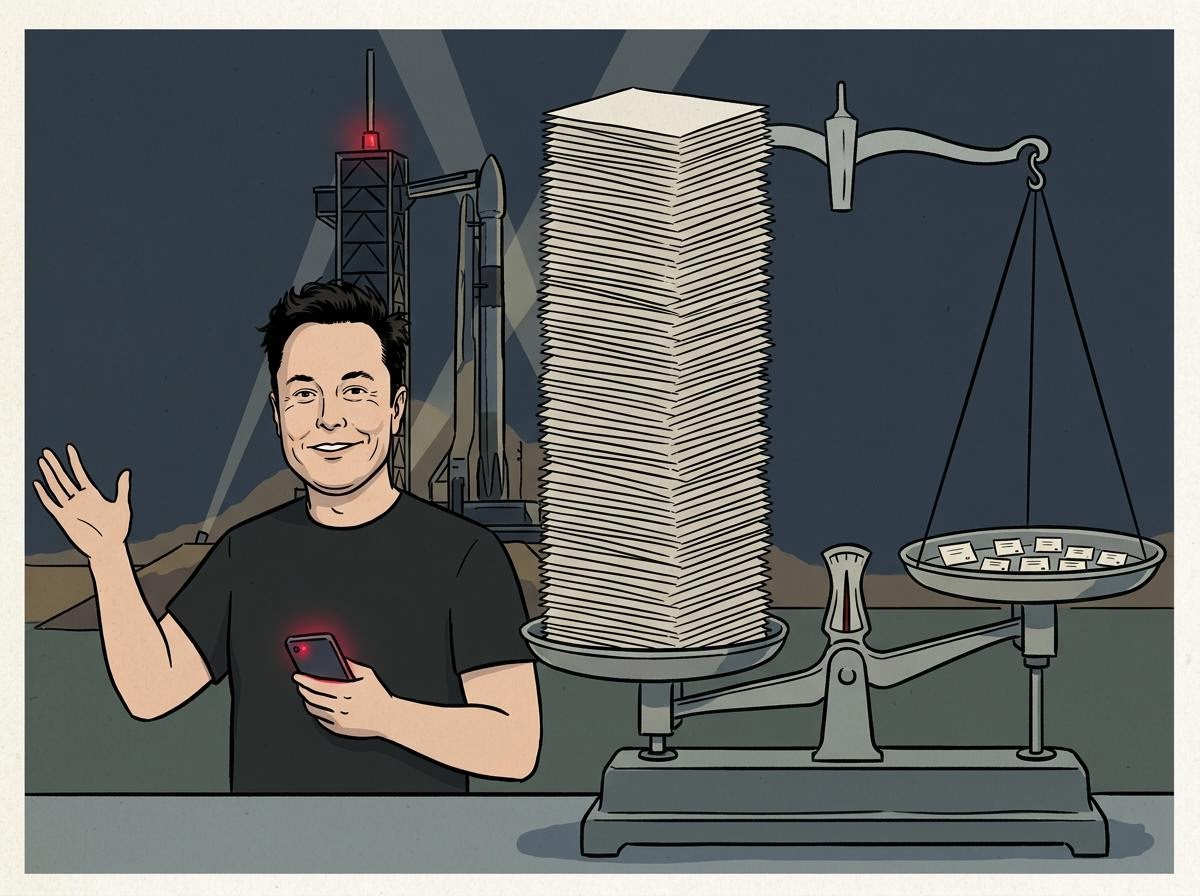
Lorn Tusk, the rocket entrepreneur who makes corporate announcements from his phone, has pledged one of his shares in UniverseY-SI, his rocket-and-satellite business, to every child in the United States, starting next year.
The proposal would give families a small financial interest in the company’s success. Tusk would retain a considerably larger interest, now accompanied by a national audience encouraged to describe it as something they have in common.
“The children get one share each. I get to say we are all in this together without making our positions remotely comparable.”
09:46
Using a count of roughly 72 million children, the promised gift is estimated at $10.5 billion. That is substantial money, not a voucher or an invitation to watch a launch.
The distinction matters. A free promotional cap merely asks someone to advertise a company. A share gives them a financial reason to hope the advertisement works. The company has found a giveaway that recruits its own supporters without requiring gratitude.
10:38
The shares appear destined for government-backed, tax-advantaged investment accounts for children. The account provides a place to hold the gift; the gift provides a reason for households to start following a rocket company’s business results.
“I want every family to ask whether what is good for me is good for them,” Tusk said. “One share makes the answer technically yes, which saves a tremendous amount of argument.”
12:14
The emerging proposition is broader than financial education. Families would learn the familiar lesson that shares can rise or fall, alongside the less familiar lesson that a billionaire’s difficult quarter is now a small household setback.
Nothing requires recipients to endorse the company or its founder. The arrangement simply places a tiny financial reward on their doing well, where previously the public was free to assess them without checking a balance.
14:27
A share is a small ownership stake, not an instruction to diversify the national economy around its issuer. That distinction is expected to become harder to hear whenever the company describes its ambitions.
A request to expand operations can now be presented alongside the interests of millions of beneficiaries. The children need not be consulted. Their presence in the ownership records supplies the family dimension; management can continue supplying the requests.
16:55
The central achievement is not a financially significant event for families or a change in who runs UniverseY-SI. It is a change in who can be invoked when explaining why its success matters.
“The children get one share each,” Tusk said. “I get to say we are all in this together without making our positions remotely comparable.”
The promised transfer remains ahead. The expanded definition of the public interest is available immediately.
The inevitable…
By March 1, 2027, Tusk will publish eligibility rules for the promised share giveaway. The document will establish which children qualify for the asset, bringing administrative precision to a promise whose promotional benefits required no application.
Check back March 2027