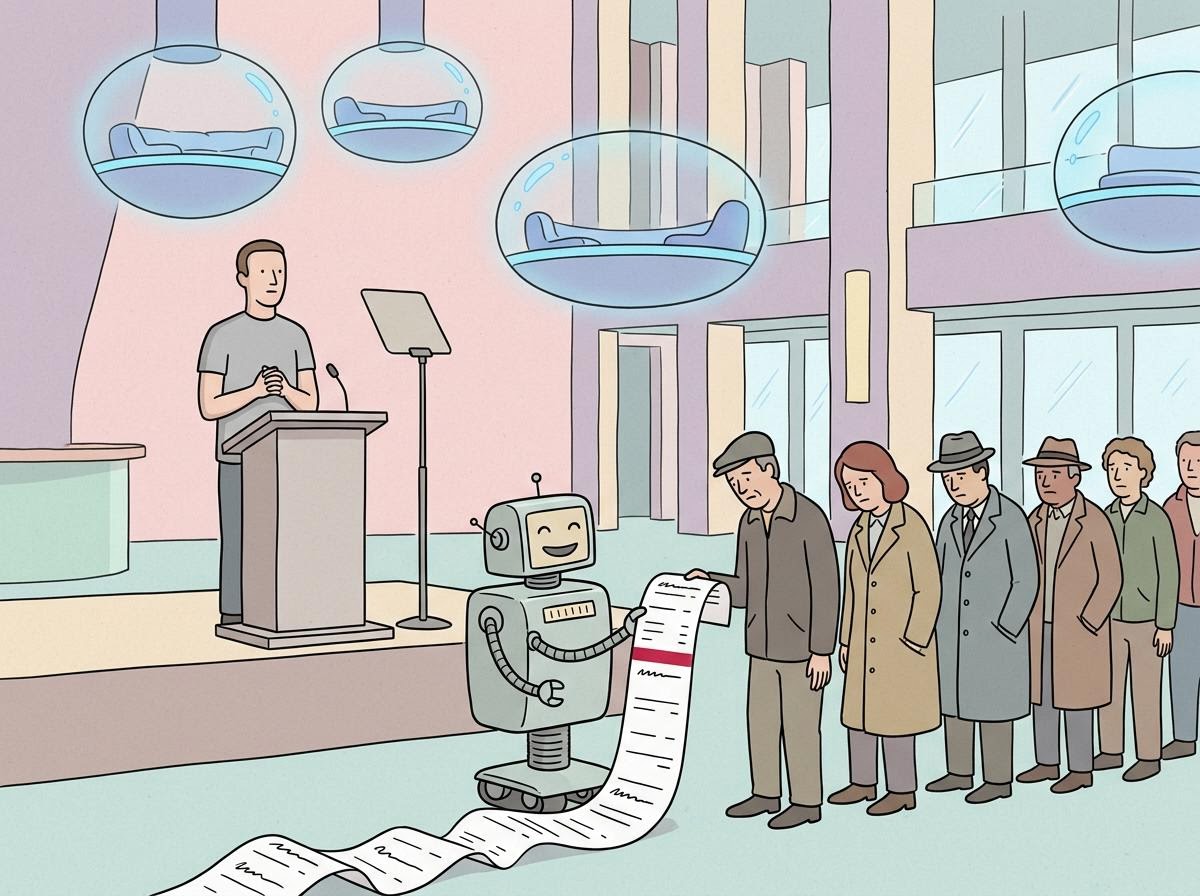
FOR IMMEDIATE RELEASE. Feta today marks a milestone in American innovation: its network of data centres, which the company has long regarded as buildings, has been found by Feta to be research. The finding qualifies for roughly $6.6bn in federal tax breaks, and Feta is pleased to share the credit with everyone who paid for it.
The announcement follows a letter from a group of senators asking whether the company's use of research credits to fund construction is, in their word, dubious. Feta welcomes the letter and has filed it under 'external feedback', a folder reviewed by the people who designed the strategy.
“Every great laboratory needs public funding and a control group. The public funded it, and it was also the control group, so the study was never at risk.”
What the company is saying
"A data centre is a place where we try things," said Marc Humanberg, Feta's chairman and chief executive. "Some of the things we try are models. Some of the things we try are depreciation schedules. History will record that we built the largest laboratories ever assembled and that the public funded the walls."
Ruse, Feta's chirpy assistant, which was asked to sort things into categories before it could finish saying 'on it', added its own view. "On it! I have reviewed the cooling system, the roof and the car park, and all three show signs of curiosity. I have saved the finance team nine hours of deciding whether a fence is a hypothesis."
Benefits for you, the unconsulted investor
Feta is committed to sharing the upside of this programme with the public in the following ways:
Shared ownership of risk. Taxpayers now carry part of the construction cost of facilities that Feta says will transform society, with no seat on the board, no access to the buildings and no say in what is researched there.
Scientific rigour. Every hall is classified as a lab on the strength of a methodology Feta describes as 'proprietary', which means 'not available to senators until they ask twice'.
Local employment. Each facility creates dozens of permanent jobs, which Feta counts as a benefit and the credits count as a reason.
Transparency. Feta will answer the senators' questions in full, in writing and in due course. Due course is currently under study.
Legacy. Future generations will inherit the data centres, the electricity bills and, Feta is proud to note, the precedent.
Next steps
Feta says it remains confident its approach complies with the law as Feta reads it, a reading it describes as 'consistent, sincere and ours'. If the questions continue, the company will review whether to reclassify the senators' letters as customer research.
About Feta
Feta is a social media and extended reality company that connects three billion people it describes as family, has not consulted, and now co-funds the family home. Its mission is to bring the world closer together, preferably inside a building that qualifies for a tax credit. Feta has been described as a good company by Feta. For media enquiries, please contact the experiment.
The inevitable…
The senators will receive a detailed reply stating that Feta complied with every rule it was able to interpret, and the credits will be reviewed in the manner of all great research: slowly, at a cost to others, and with the conclusion fixed in advance. The next data centre will be classified as a study of how the last one was received, and the public will be thanked for its participation in both.
Check back October 2027