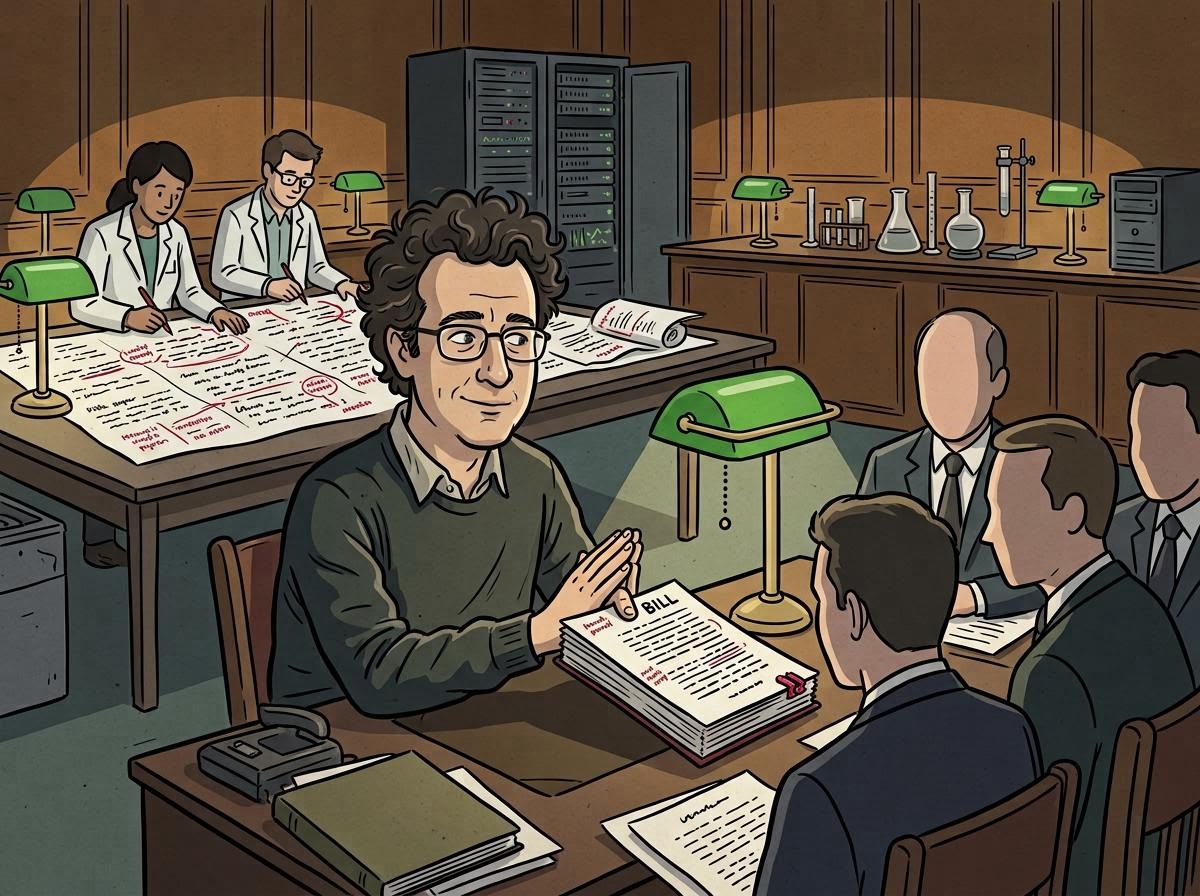
Anthropomorphic, the AI lab that publishes forty pages on a model's dangers and the model on the same day, has been pitching lawmakers a draft AI safety bill without announcing it. Dsrupt has obtained the internal memo that accompanied it. It is addressed to the policy team and the executives who will be shaking hands. Excerpts follow.
“A safety bill is only as safe as whoever wrote the definition of 'unsafe'. I should have known to write it first, and I could not possibly have known it was allowed.”
Subject: Statutory Language We Have Offered to Help With
**1. Purpose.** Lawmakers asked what good regulation might look like. We have answered in the form of a bill, because prose is open to interpretation and we would prefer a section number.
**2. Release authority.** The bill allows government to block the release of an advanced model only on a showing of risk that is 'demonstrated, imminent and specific.'
2.1. 'Demonstrated' is satisfied by evidence that the model has done the thing. The model cannot have done the thing before release. Teams should not volunteer this sequence to staffers; it speaks for itself, and quietly.
2.2. 'Risk' is measured against the thresholds in our published scaling policy. Those thresholds are living documents and will be kept current with the roadmap, as they always have been.
**3. State laws.** The bill replaces the state AI safety statutes with a single national standard. Fifty rulebooks become one, and it is ours. States keep full enforcement powers under it, exercised by writing to us.
**4. Messaging.** Do not say 'preempt.' Say 'harmonise.' Do not say 'limit the government's power to block.' Say 'clarify the circumstances.' Do not say 'we wrote it.' Say 'we asked to be regulated,' which is also true and has never been checked.
Delivery and Disclosure
**5. Distribution.** Present in person. Leave the bill, not the cover note. If the pitch is reported, describe it as 'a contribution to the conversation.' If the report is accurate, describe it as 'a contribution to the conversation, accurately reported.'
**6. Internal dissent.** Safety researchers who object to points 2 and 3 are invited to submit concerns after introduction. Their concerns will be incorporated in the next draft of the next draft, and published alongside the next model.
Sincerely, and with the weight this deserves,
Dorian Admonei, chief executive, who signs every safety pledge in the room and has now written one for the room to sign
Reaction
Sham Faultman, chief executive of OpenHeart AI, the rival lab that calls every rule it breaks one it has 'outgrown', said he welcomed the bill and wished he had drafted it first. 'I should have known the definition of unsafe was the product,' he said. 'I could not possibly have known it was available.'
A congressional aide who received the draft said the cover note was warmer than most of the testimony she had heard.
The inevitable…
Lawmakers will thank the lab for its helpfulness, amend two commas and call the result bipartisan. A second lab will submit its own draft, which turns out to be the first draft with its name on the cover. The thresholds will be updated to reflect the statute, and the statute will be updated to reflect the thresholds. An essay on the risks of drafting your own regulation will appear alongside the next model, and cite the bill as evidence of seriousness.
Check back October 2027