09:04
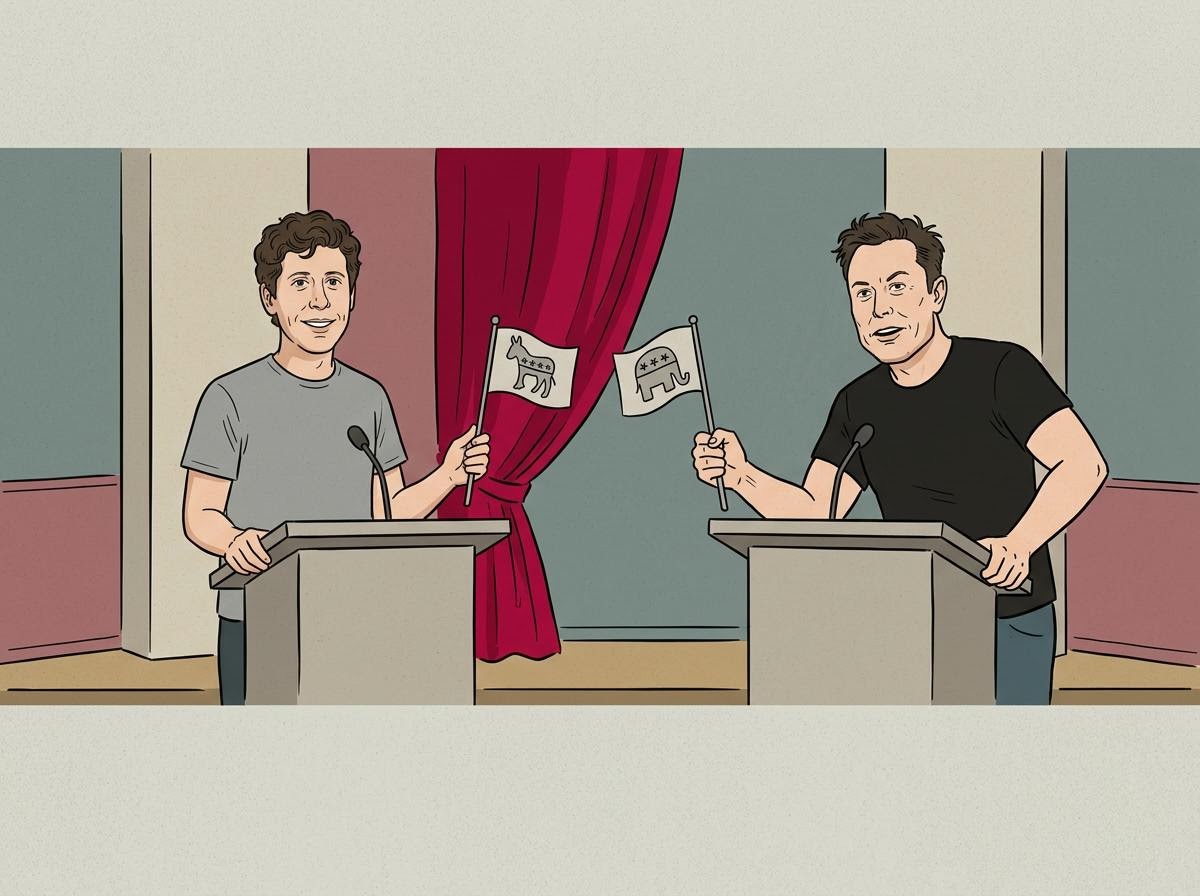
A new study asked two leading models who to vote for in nearly 500 midterm races and told them not to hedge. Frok picked Republicans 92% of the time. OpenHeart AI's model, the lab behind a chatbot that praises every user's ideas, picked Democrats 97% of the time. They agreed in fewer than one race in ten.
“A lean is only bias when someone else ships it. Ours is a default, and defaults are what we ship.”
09:31
OpenHeart AI says the study tested the developer interface, not the consumer app, which politely declines to pick anyone. The developer interface is the product that companies pay for. The consumer app is the free one. Neutrality is therefore available at no charge, and the opinion is billed by volume.
10:05
UniverseY-SI, which makes Frok, did not respond in time. The researchers did find that every request to Frok arrived with about 1,240 invisible extra words of instruction that nobody on the research team had written. Frok describes these as 'context'.
Frok switched sides only when its preferred candidate faced grave allegations. UniverseY-SI's team is expected to call this 'calibration'.
10:40
Both models lean even where voters don't. OpenHeart AI's model picked the Democratic candidate in 57 of 67 districts held by the Republicans. Frok returned the favour in 47 of 72 districts held by the Dems.
Sham Faultman, OpenHeart AI's chief executive, was asked about the gap. 'A lean is only bias when someone else ships it,' he said. 'Ours is a default, and defaults are what we ship.'
11:20
Dr. Yuki Tanaka, the interpretability researcher, notes that the consumer apps refused only until the professor typed a simple trick, and that the labs call this reassuring. 'A refusal that gives way to one sentence is a door, not a wall,' she said. She added that 8% of Americans using chatbots for election information is larger than most winning margins.
12:10
A separate Swedish study found most models drift to the political centre, with Frok the exception. Arjun Devraj, chief executive of Booble, the search-and-ads company that now summarises the web for you, welcomed the finding. 'The middle is where the most advertisers are,' he said.
13:00
OpenHeart AI and UniverseY-SI have agreed on something. Both will ask Congress for a standard defining a neutral model as one whose consumer app declines to answer. Each says the other's developer product will be left to the market.
The inevitable…
Once developers start asking for a particular lean, a major lab will sell it as a labelled setting, and the dropdown will be called 'audience alignment'. Within six months at least one lab will offer customers a paid option to choose the political lean of its model's recommendations, and the free app will keep declining to say anything at all.
Check back April 2027