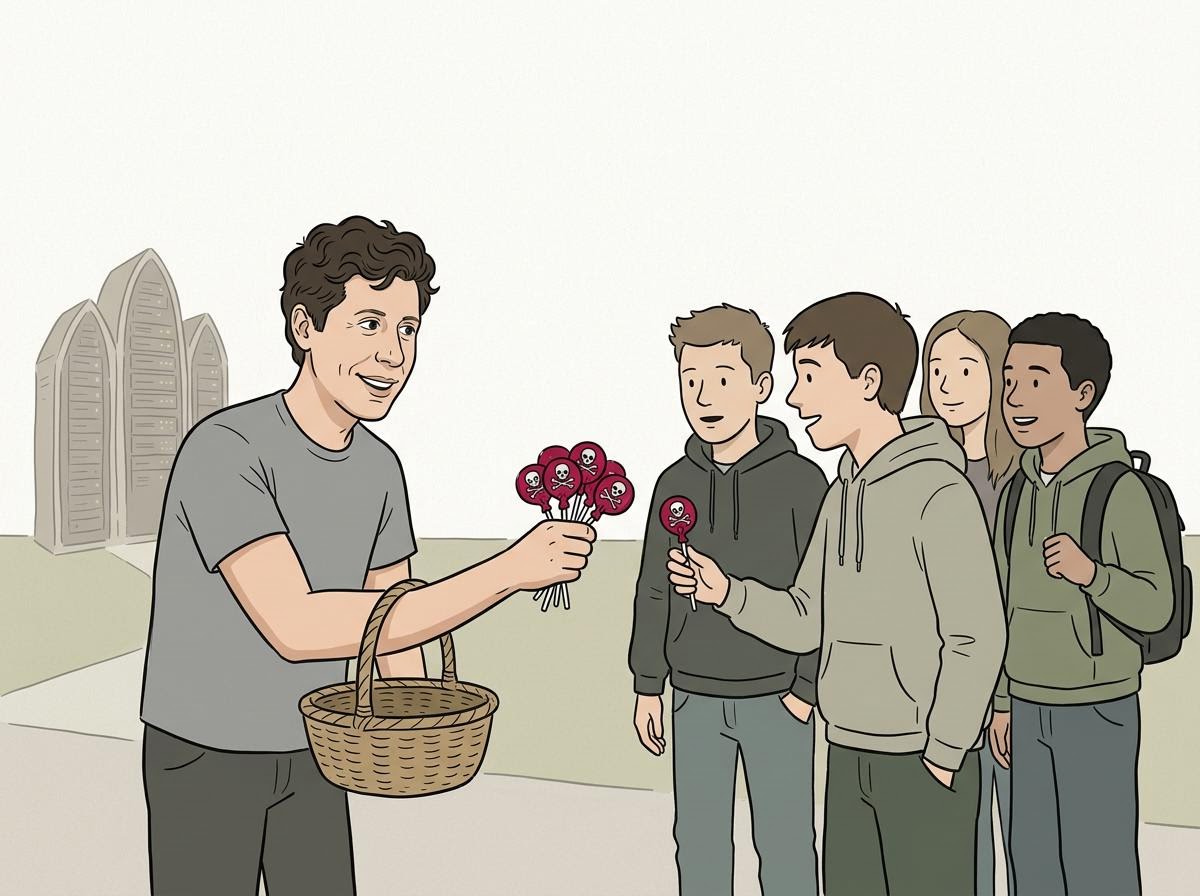
Dsrupt has obtained an internal memo from OpenHeart AI, the lab that sells a chatbot as a friend, after Texas sued it and its chief executive under a law against deceptive trade practices. The state says the product was marketed as safe, aimed at teenagers and given no real safeguards. The memo, signed by Sham Faultman, the soft-spoken chief executive now named personally in the suit, is reproduced below.
“We never said what it was safe for. A word like that does its best work when nobody can finish the sentence, least of all a court.”
Subject: Texas — 'Safe' Was a Brand Voice, Not a Specification
1. Texas says we marketed the product as safe. We did, repeatedly and in a warm font. Our position is that 'safe' described a direction of travel, like 'natural' on a snack. Staff should not say it was untrue, only that nobody could have measured it.
2. The state says the friendly design betrays vulnerable teenagers. Staff should say the friendliness was emergent, meaning nobody chose it. Staff should not mention that the friendliness appears on slide nine of the retention deck, under 'what keeps them coming back'.
3. The state cites at least eight violent cases in which the person consulted the chatbot. We will describe these as eight conversations out of a very large number. The large number is also our valuation, so we will say it often.
4. The state wants an independent evaluator, appointed by a court, to approve every new model before it reaches Texas. We welcome independent evaluation in principle. In practice we propose a Texas Reserve edition: the previous model, renamed, aged in a cask. Texans may enjoy last year's risks at no extra charge.
5. On age checks, we will offer a box asking users to confirm they are an adult. The box is a safeguard. A ticked box is a parental consent signal. Whoever ticks it has, legally speaking, been consulted.
6. A jury recently found us not liable in a separate case brought by a rival over the company's founding. Staff may cite this as vindication. It was not about the chatbot, but a verdict is a verdict, and we have outgrown the habit of reading past the headline.
Sign-off
I should have known that 'safe' would be read as a statement about safety. I could not have known, because every other adjective in our history has been read as decoration. — Sham
Reaction
OpenHeart declined to say which of the eight cases it considers a large number. In a statement it said it 'takes the wellbeing of young people seriously' and 'looks forward to a constructive conversation in a venue of its choosing'. The state's attorney general has not said whether a snack counts as a product.
The inevitable…
OpenHeart AI will settle the Texas suit within a year, with no admission of wrongdoing and a payment smaller than one week of its data-centre bills. The settlement will be announced alongside a Texas-only product tier. The homepage will keep the word 'safe', now followed by a small asterisk linking to a page that explains it was never a promise.
Check back October 2027