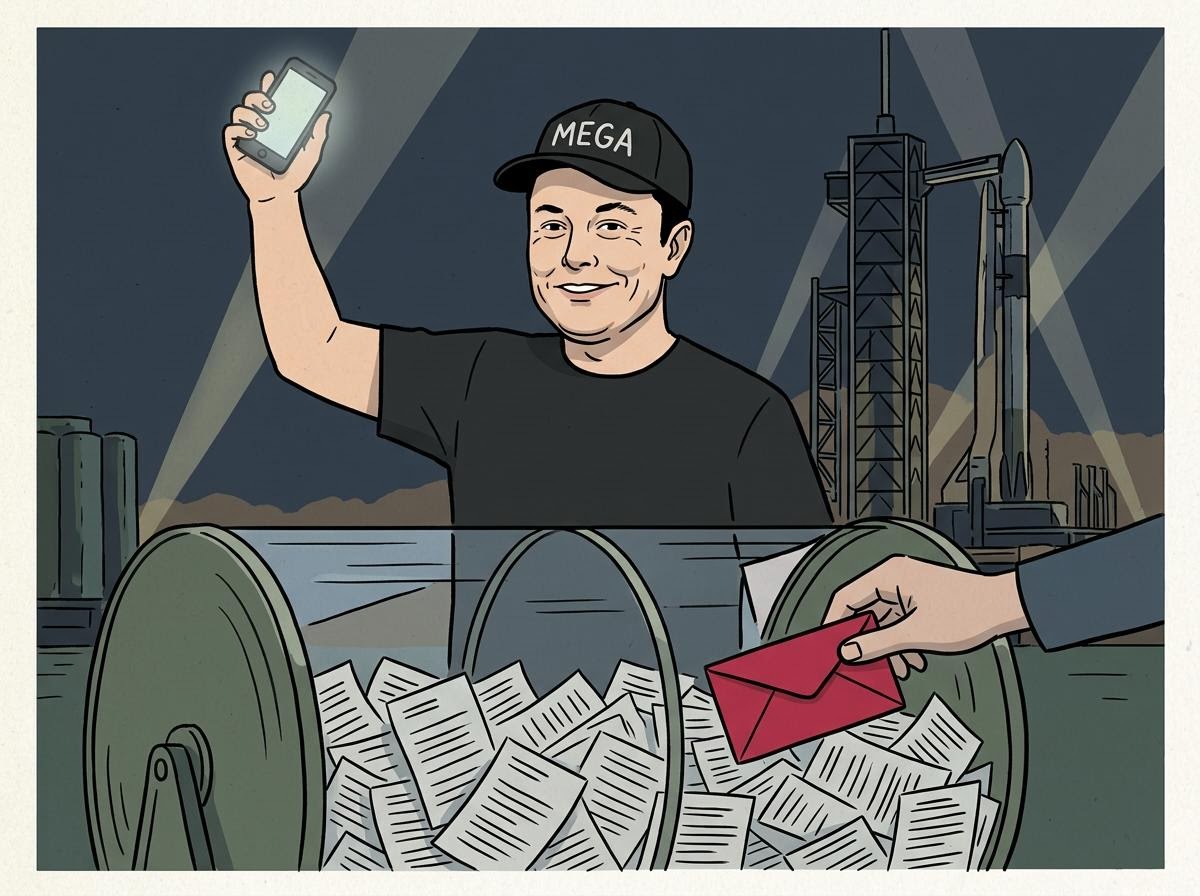
It was never a lottery
Two residents of Arizona sued me, in Austin, claiming my $1 million-a-day giveaway to swing-state voters was not random. I have settled both suits, for a sum I am not required to tell you. Naturally the headlines say this proves they were right. It proves they were early.
My lawyer told a court that the winners were not chosen by chance and that we knew exactly who would be announced before the announcement. Critics call this a contradiction. I call it disclosure, delivered in the one room where nobody was in a hurry to share it on the internet.
“'Random' is what you call a prize when you want people's data, and 'predetermined' is what you call it when a judge wants an explanation. Same million, two audiences, and I only paid one of them.”
Suitability beats luck
A lottery picks winners by luck. That is its flaw. Luck gives you a retired dentist in a town with no signal who has never once amplified anything. I wanted spokespeople, so we selected for suitability, paid them $1 million each, and called the payment a prize because 'signing bonus' tests poorly in the Midwest.
A court in Pennsylvania accepted this: the money was pay for work, not a prize. I am proud of that ruling. It is the first time a judge has certified that a million dollars can be a salary for a job the person was not told they had.
The petition was a job application
To enter, voters signed a petition and handed over their personal details. One plaintiff says she would never have done so had she known she was being treated as a marketing prop. This is the exact misunderstanding I am trying to correct. She was not a prop. She was a candidate for being a prop, which is a much more competitive status, and the petition was the applicant-tracking system.
Yes, the petition set no limits on what my PAC could do with the data it collected. People call that a loophole. I call it a growth-stage product with a flexible roadmap, much like the social platform I own, Z Corp, where policy is also finalised after it has been used.
The number stays secret for your protection
Last month a federal judge said I would have to testify. I now will not have to, which is a coincidence in the sense that most things are. A settlement that is sealed also spares everyone the awkwardness of learning what a word costs.
Consider the economics. Hundreds of thousands of verified, motivated, battleground-state contacts, for a daily $1 million plus an undisclosed legal bill. Marketing departments pay more for worse lists and then must listen to focus groups. I only had to listen to a judge, once, in writing.
Some will say I lied to voters. I say I told them a number and a mood. Both were accurate. The number was a million. The mood was 'random'. Moods are not warranties.
The inevitable…
The court will approve the settlement, the terms will stay sealed, and the word 'random' will return in the next election, cleaned and rebranded as 'curated opportunity'. The next batch of petition signers will hand over their details just as readily, because the sum paid to the last batch will never be published to warn them.
Check back October 2027