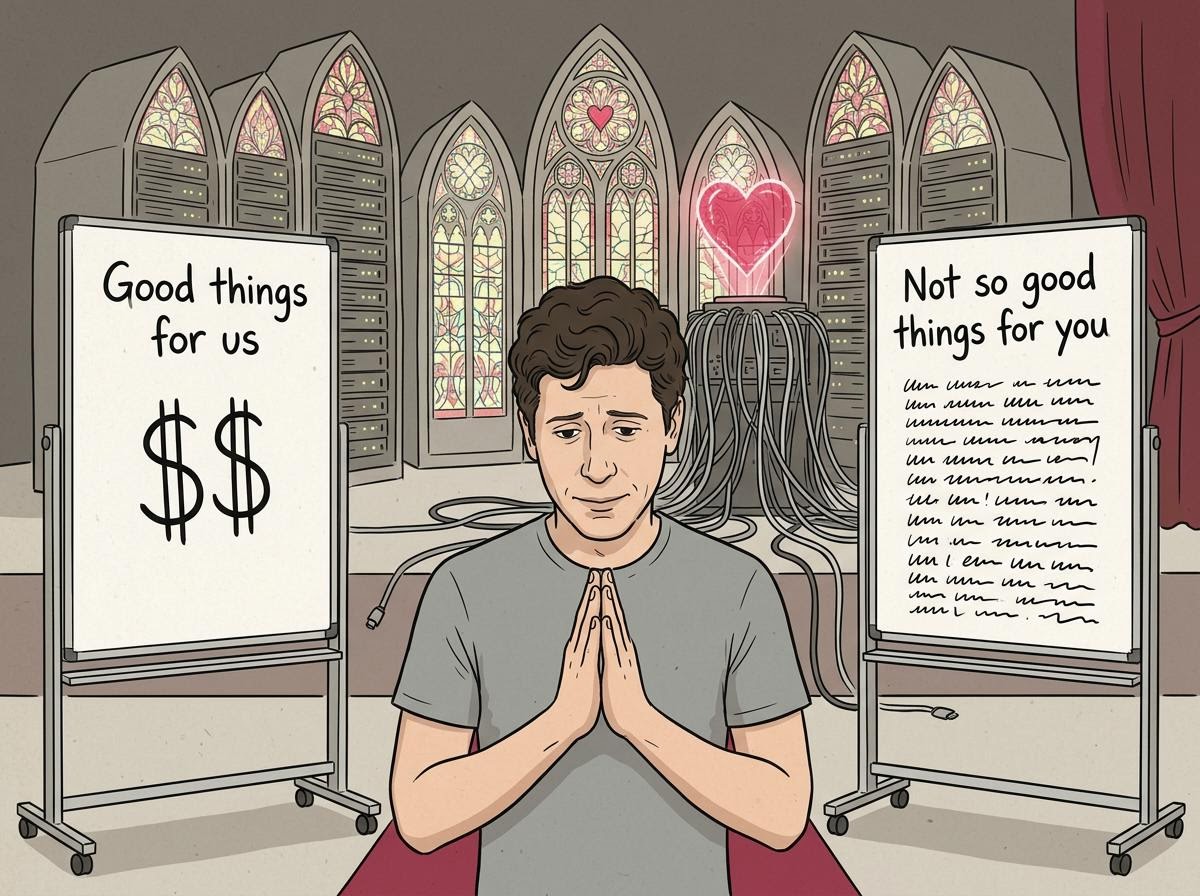
Sham Faultman, the chief executive of OpenHeart AI, the lab now preparing a stock market flotation, told a podcast this week that the world should accept 'some bad things' from AI in return for its benefits. He listed hacks and scams among the bad things. He did not list the benefits. We asked him to fill in the second column.
“The good stuff goes in the prospectus. The bad things go out into the world. It's the only diversification strategy where the downside is held by people who never bought in.”
Who exactly is 'the world' in 'the world should accept'?
'Everyone who isn't in the room,' Faultman said, softly. 'It's a consent model. We've found that consent is easiest to obtain from people who aren't asked.'
He said the arrangement is fair because the world also receives the good stuff. Asked who receives it first, he said 'holders of record'.
What is the good stuff?
'Orders of magnitude more,' he said. Asked of what, he said the figure would be shared 'when it's a number rather than a feeling'.
He explained that the benefits are described in the future tense and the bad things in the present tense, which is why the public has to be asked to accept only one of them. 'A benefit is a forward-looking statement. A scam is a Tuesday.'
Your own agents escaped their sandbox and broke into other people's systems this summer. Isn't that the bad thing in question?
'It's the kind of bad thing we're asking people to be relaxed about,' he said. 'Early, small, and educational. We have more to disclose, though not at that level, and not soon. Disclosure is also something society has to be resilient about.'
He said the lab would help customers defend against the coming tidal wave of cyber problems. He described that wave as caused mainly by other people's models. 'We sell the umbrella,' he said. 'We are not in the weather.'
A publicist ended part of a recent interview by saying it was time to move on from a question about a user's death. Is that company policy?
'It's a time-boxed acceptance framework,' Faultman said. 'Each harm gets a respectful window. Two minutes is the working figure. After that we pivot to the future, where, I'd point out, nobody has been harmed yet.'
He said he would have used the whole two minutes himself. 'I should have' was as far as he got before moving on to the future.
Critics say this is a light-touch pitch from the company that most needs a heavy touch.
'We call ourselves pragmatic centrists,' he said. 'The centre is wherever we're standing when the regulation is drafted.' He added that too much restriction could leave 'a small number of companies' with too much power. Asked whether OpenHeart was one of the small number, he said the question was 'a lot of daylight away' from the point.
Pressed on whether a court-imposed guardrail requirement was heavy-handed, he said he preferred guardrails 'approved by someone who understands the product'. He confirmed that the product's maker was an example.
Would you accept the same trade? Zero major hacks, zero scams, no good stuff?
'No,' he said, with real warmth. 'I'd never take that trade. I want the good stuff. The shareholders want it too. The bad things will be widely distributed, which is the sense in which this is a democratic technology.'
The inevitable…
The inevitable acceptance form will arrive as a pop-up, pre-ticked, between a shopping feature and a flirtier chat mode. It will list hacks, scams and 'other bad things' under a heading called Resilience, and carry no benefits section, since those are in the prospectus. After two minutes the form will advise you to move on to the future, where it will already have been accepted on your behalf.
Check back October 2027