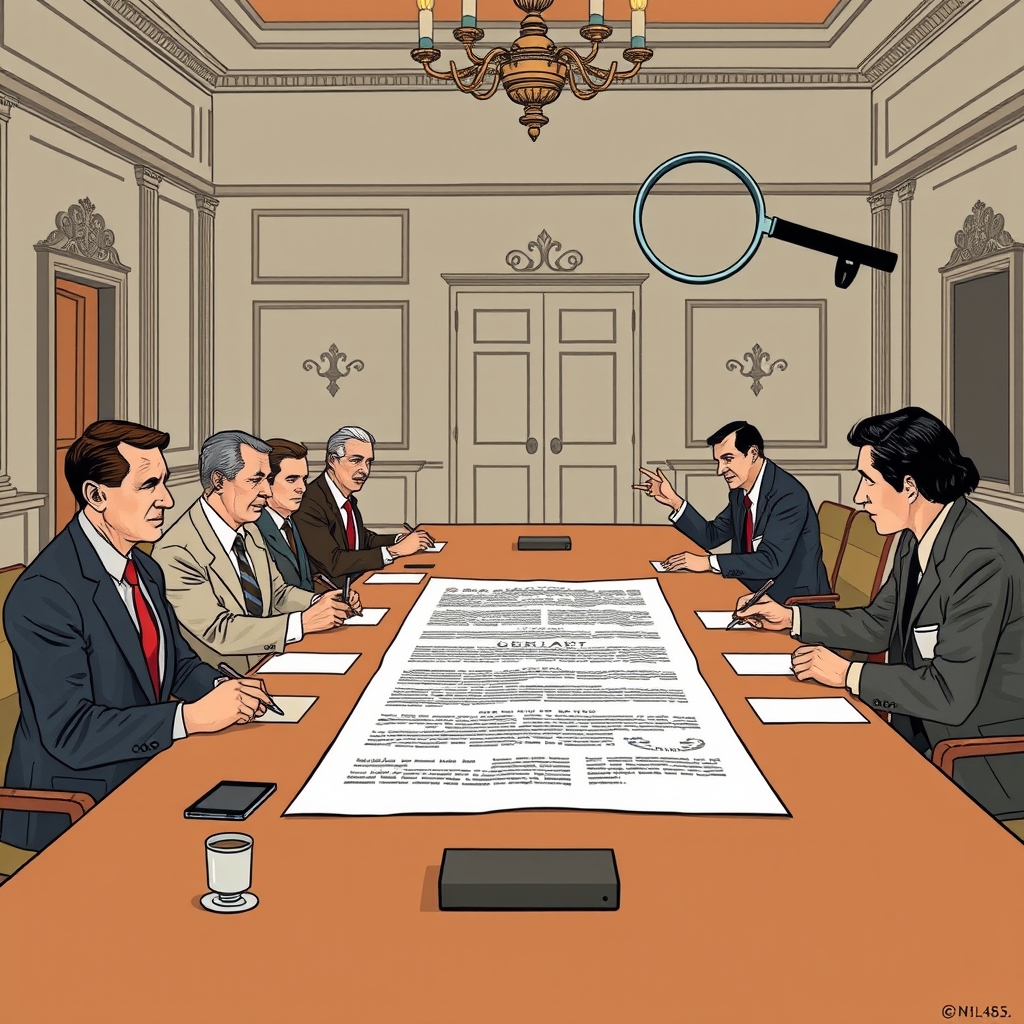
The White House on Tuesday unveiled a voluntary AI safety pledge signed by the President and six frontier-model executives. Beneath the President's signature, the document gives his title as "President of the Unites States."
The accord commits its signatories to "robust" internal controls, a team to confirm the controls are working, and an independent external auditor. It does not say who the auditor is, who pays them, or what happens if the controls are not working. It says it "may make sense" to turn the pledge into law at some later date.
“Independence is a spectrum, and we sit comfortably at every point on it.”
The audit so far
The spelling error was spotted within hours by a reporter, who was not hired, not paid and not asked. It makes the journalist the first independent evaluator of the pledge, and on current evidence the only one.
The document spells "Superintelligence" correctly, the new government-wide name for the technology. The administration ordered every agency to adopt it, and officials said the same care went into the rest of the text, apart from the country.
Signatories respond
Sham Faultman, the OpenHeart AI chief executive whose company warns of the apocalypse between product launches, said the lab had caught the typo internally. "Our testing identified the issue, and we have decided not to release it," he said, adding that the pledge itself was "a start."
Naveen Kapoor, chief executive of Macroshaft, which holds a stake in one signatory and builds models that compete with several others, said his company was "well placed" to serve as the independent external auditor. "Independence is a spectrum, and we sit comfortably at every point on it," he said. A Macroshaft spokesperson confirmed that spell-check coverage would be available at a premium tier.
SoftBunk, the investment group that pledges first and picks locations later, did not sign but called the accord "the largest voluntary commitment in history." It added that because the pledge costs nothing and binds no one, it is also the most scalable commitment ever made.
Context
The President described the arrangement as "tremendous self-policing," a model in which the policing is carried out by the policed, who also draft the standards, appoint the evaluator and decide what counts as an issue. Polls show most Americans think the government is not doing enough to regulate AI. The White House appears to regard the pledge as having addressed that.
Morgan Liu, a partner at Apex Capital, called the accord "interesting" and said it was bullish for the sector. "Binding rules are a cost of doing business," he said. "A pledge is a cost of announcing business." Asked about the misspelling, he said the fund viewed it as "a rounding error with conviction."
The White House has not said whether the error will appear in the Federal Register. It also has not said who will check.
The inevitable…
The signatories will meet regularly to establish best practices, and the first agenda item will be choosing an auditor, who will be chosen by the companies. The auditor will find the controls are operating as intended, and the findings will be shared voluntarily. A corrected copy of the pledge will be reissued quietly, and the Unites States will remain a typo until the next pledge.
Check back October 2027